


 русский
 Español
 Deutsch
 عربى
عربى
Industry News


When Fire Hose Couplings Meet Different Standards, What Changes
 2026.10.02
 Industry News
Content
- 1 Which Standards Are Commonly Seen?
- 2 Does the Same Diameter Mean the Same Connection?
- 3 What Changes With a Different Standard?
- 4 Why Do Adapters Matter?
- 5 Could Standards Affect Large-Diameter Hose Systems?
- 6 What Should Be Listed on a Coupling Specification?
- 7 Standard Awareness Prevents Costly Mismatches
Fire hose couplings may look similar across different markets, but their connection standards can vary considerably. A coupling designed for a U.S. fire hose system may not connect directly to equipment built around a British or European specification. The difference is not simply a matter of inches versus millimeters. Thread profile, coupling geometry, sealing method, and connection design can all change.
This makes standards a critical consideration for fire fighting hose couplings. Understanding the applicable standard can help buyers avoid ordering a fitting that has the correct nominal diameter but cannot physically connect to the existing equipment.

Which Standards Are Commonly Seen?
Different regions have developed their own approaches to fire hose connections. In the United States, NFPA specifications cover threaded and nonthreaded fire hose connections, while BS 336 defines requirements for fire hose couplings and related equipment in the British market. Storz is another widely recognized coupling format, particularly across European and international applications.
| Connection Type | Typical Market | Connection Principle |
| NH / NST | United States | Threaded male/female connection |
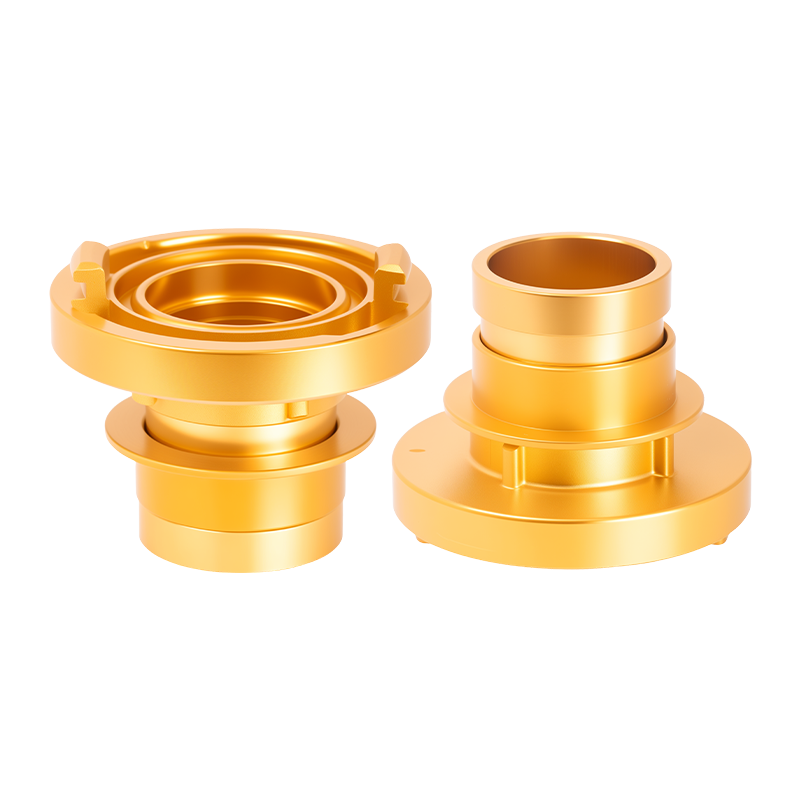
| Storz | Europe / international markets | Symmetrical lug connection |
| BS 336 | United Kingdom | Instantaneous-style fire hose connection |
| NPSH | Selected North American applications | Straight hose thread |
NFPA's current fire hose connection framework covers coupling and adapter requirements, screw threads, nonthreaded connections, and gaskets. NFPA 1963 historically standardized threaded fire hose connections from small sizes through large-diameter configurations, illustrating how dimensional details are essential to interchangeability.
Does the Same Diameter Mean the Same Connection?
No. Nominal diameter provides only part of the information needed to identify a compatible coupling.
Consider a 2½-inch threaded fire hose connection. The nominal size may appear straightforward, but the actual specification can include thread pitch, thread form, external diameter, coupling depth, and gasket-seat dimensions. U.S. National Standard fire hose thread specifications, for example, define dimensional details beyond the nominal waterway size.
- Nominal diameter identifies the general connection size.
- Thread pitch determines how threaded male and female components engage.
- Thread profile affects physical compatibility.
- Gasket-seat dimensions influence the sealing interface.
- Coupling geometry determines how nonthreaded connections lock together.
What Changes With a Different Standard?
1. Thread Geometry
Threaded fire fighting hose couplings depend on matching thread specifications. ASME B1.20.7, for example, covers hose coupling screw threads used for hose couplings, valves, nozzles, and related fittings. The standard describes the normal connection sequence as an externally threaded nipple entering an internally threaded coupling.
A coupling can therefore have a familiar size while using a different thread specification. For replacement projects, identifying the thread standard is just as important as measuring the coupling diameter.
2. Connection Mechanism
Not every fire hose coupling uses threads. Storz connections use a symmetrical coupling arrangement, while British instantaneous systems use a different locking principle. This means a change of standard can completely alter the physical connection process.
For example, BS 336:2010 covers fire hose couplings and ancillary equipment and specifies applications involving delivery and suction hose, with the standard addressing firefighting equipment up to a stated working pressure of 16 bar.
3. Gasket and Sealing Design
Changing standards can also affect the sealing interface. A threaded coupling may rely on a gasket seated against a defined surface, while a nonthreaded coupling can use a different gasket arrangement.
Modern NFPA requirements address gasket grooves, gasket performance, minimum waterway, testing, coupling retention, temperature performance, and other characteristics. These details show that a compatible coupling is more than a component with matching threads.
Why Do Adapters Matter?
Different standards do not necessarily mean that equipment from different regions cannot work together. Adapters can provide a controlled transition between two connection types.
| Existing Connection | New Equipment | Possible Solution |
| NH / NST threaded | Storz | Thread-to-Storz adapter |
| Storz | Threaded hydrant connection | Storz-to-thread adapter |
| Different threaded standards | Matching hose equipment | Standard-specific thread adapter |
| Different nominal diameters | Large or small hose | Reducer or increaser |
The adapter itself still needs to meet the required dimensions and performance requirements. A poorly matched transition can introduce another compatibility problem rather than solving the original one.
Could Standards Affect Large-Diameter Hose Systems?
Yes. Standardization becomes particularly significant as hose diameter increases. Historical NFPA documentation notes that nonstandard threads on 4-, 5-, and 6-inch supply hose once created interchangeability problems between pumping equipment. Standardized dimensions were subsequently developed to address these connection differences.
This history explains why large-diameter fire fighting hose couplings should be specified with detailed connection information rather than a simple diameter description.
What Should Be Listed on a Coupling Specification?
- Nominal coupling size
- Applicable connection standard
- Thread designation and pitch for threaded designs
- Male or female configuration
- Gasket type and sealing dimensions
- Working and test pressure
- Material and manufacturing specification
- Required adapter configuration
Standard Awareness Prevents Costly Mismatches
Different fire hose standards exist because firefighting systems have developed around regional equipment, infrastructure, and technical requirements. The result is a market containing threaded, lug-type, symmetrical, and other connection formats.
For buyers, the key point is simple: diameter alone does not define compatibility. Thread details, coupling geometry, gasket dimensions, pressure requirements, and the applicable standard all need to be considered.
As international fire protection projects increasingly involve equipment from different suppliers and regions, correctly specified fire fighting hose couplings and suitable adapters can provide a practical bridge between different connection systems.
Related Products


-
 (+86) 18968568369
Give Us A Call
-
 [email protected]
Drop Us a Line
-
 No. 32, Mechanical and Electrical Industrial Park, Donghai Avenue, Yuhuan City

Zhejiang Taizhou Honghe Technology Co., Ltd. is an emerging enterprise focusing on the research and development, production and sales of fire fighting equipment.
© 2025 Zhejiang Taizhou Honghe Technology Co., Ltd.
Storz Coupling & Firefighting Equipment Factory
